Summary: Key points of NetEnt obtaining the Pennsylvania license
In October 2017, Pennsylvania passes a law authorising online casino gaming, laying the foundations for a strictly regulated iGaming market.
With nearly 13 million residents, the state quickly becomes one of the most strategic iGaming markets in the United States.
On March 20, 2019, the Pennsylvania Gaming Control Board (PGCB) grants NetEnt a conditional license through its subsidiary NetEnt Americas LLC.
This license allows NetEnt to prepare the integration of its online games ahead of the official market launch.
NetEnt adopts a forward-looking strategy by signing agreements with several American operators prior to the launch.
The studio’s stated objective is to be operational from day one of the opening of the online gambling market in Pennsylvania, without any additional delay.
This license represents a key milestone in NetEnt’s U.S. expansion, reinforcing its credibility with regulators and local partners.
NetEnt obtains a conditional license in Pennsylvania
When the Pennsylvania Gaming Control Board (PGCB) grants a conditional license to NetEnt on March 20, 2019, through its subsidiary NetEnt Americas LLC, it is not merely a symbolic green light. This authorisation marks the official entry of the developer into Pennsylvania’s regulated ecosystem! At the time, it represents one of the strictest frameworks in the United States for online casino gaming.
The conditional nature of the license is central. In Pennsylvania, the regulator clearly distinguishes between initial administrative approval and final operational validation. NetEnt is recognised as an eligible supplier. In this context, it nevertheless remains subject to a series of additional checks before its games can effectively go live. This process aims to ensure that only technically robust and legally sound operators are allowed to operate on the market.
In practical terms, this license allows NetEnt to prepare the integration of its games. A process designed to develop a set of collaborations with licensed operators. At the same time, it enables the studio to adapt its products to local requirements, without immediately launching its titles to the public.
What a PGCB conditional license in 2019 really means:
Official recognition of NetEnt as a supplier compliant with the Pennsylvania regulatory framework
Authorisation to work with online casino operators holding a local license
Access to the technical integration process prior to the market opening
Submission to additional audits ahead of the commercial activation of the games
Beyond the regulatory aspect, this conditional license highlights NetEnt’s intention to establish a long-term presence on the U.S. market. In 2019, few states still offer a clear legal environment for online casino gaming. Being among the first suppliers approved in Pennsylvania allows NetEnt to position itself as a leader, by settling in a state destined to become one of the country’s most important iGaming markets.
The choice to operate through NetEnt Americas LLC is not insignificant. This U.S. subsidiary enables the group to respond more effectively to local requirements, both in legal terms and in terms of compliance with technical infrastructures and data flows. It also facilitates exchanges with the regulator and partner operators based in the United States.
Why this gaming license represents a strategic milestone for NetEnt:
Early access to one of the most promising iGaming markets in the United States
Strengthening of NetEnt’s credibility with American regulators
Positioning as a supplier ready from the moment the market opens
In March 2019, this conditional license places NetEnt in a position of active waiting. The studio cannot yet launch some games from its catalogue. However, everything is put in place so that, on the day Pennsylvania officially opens its iGaming market, NetEnt titles are already certified, integrated, and configured to be offered to players.
A legal framework established as early as 2017 for online casino gaming
The opening of the iGaming market in Pennsylvania is not the result of a sudden decision. It has its roots in October 2017, a key date when the state legislature adopts a law officially authorising online casino gaming. This vote marks a major turning point for a territory historically deeply attached to regulated gambling, but until then almost exclusively focused on land-based casinos.
This decision takes place within a specific budgetary and political context. Pennsylvania is seeking new sources of tax revenue, while maintaining strict control over the gambling industry. Online casino gaming appears as a logical extension of the existing model: a regulated system capable of generating additional revenue without undermining the structure of the land-based market.
Unlike certain jurisdictions that opted for rapid liberalisation, Pennsylvania chooses a cautious and progressive approach. The 2017 law establishes the principle of iGaming, but leaves it to the regulator to define access conditions, technical obligations and compliance rules. It is this gradual approach that explains the delay between the adoption of the law and the granting of the first licenses in 2019.
The objectives pursued by the 2017 law:
Authorise online casino gaming within a strictly regulated framework
Generate new tax revenue for the state
Protect the economic model of existing land-based casinos
Offer a legal and regulated alternative to unregulated gambling
The Pennsylvania Gaming Control Board (PGCB) is given a central role in implementing this new legal framework. Already responsible for regulating physical casinos, the authority is also entrusted with overseeing online gambling activities. It therefore establishes precise criteria for the granting of licenses, both for operators and for online gaming software providers.
This framework is based on a clear separation of roles. Operators must hold a local license and run the gaming platform. Content providers such as NetEnt, for their part, must obtain a specific authorisation to offer their games. This distinction allows the regulator to control every link in the chain.
The regulatory pillars put in place by the PGCB:
Issuance of separate licenses for operators and suppliers
In-depth checks of technical infrastructures
High requirements in terms of security and player protection
Ongoing monitoring of compliance after licenses are granted
In 2019, this legal framework is still in the phase of operational finalisation. The rules are in place, but the market is not yet open to the public. For suppliers such as NetEnt, this period represents an intense phase of preparation, during which every aspect of the product must be aligned with local requirements.
This legislative foundation laid as early as 2017 explains why Pennsylvania is already perceived, by 2019, as one of the most structured iGaming markets in the United States. The state is not seeking speed at any cost. Its ambition is to build a sustainable market, based on sound regulation capable of welcoming international players while maintaining strict control over the gaming offering.
Pennsylvania, a strategic market with strong potential
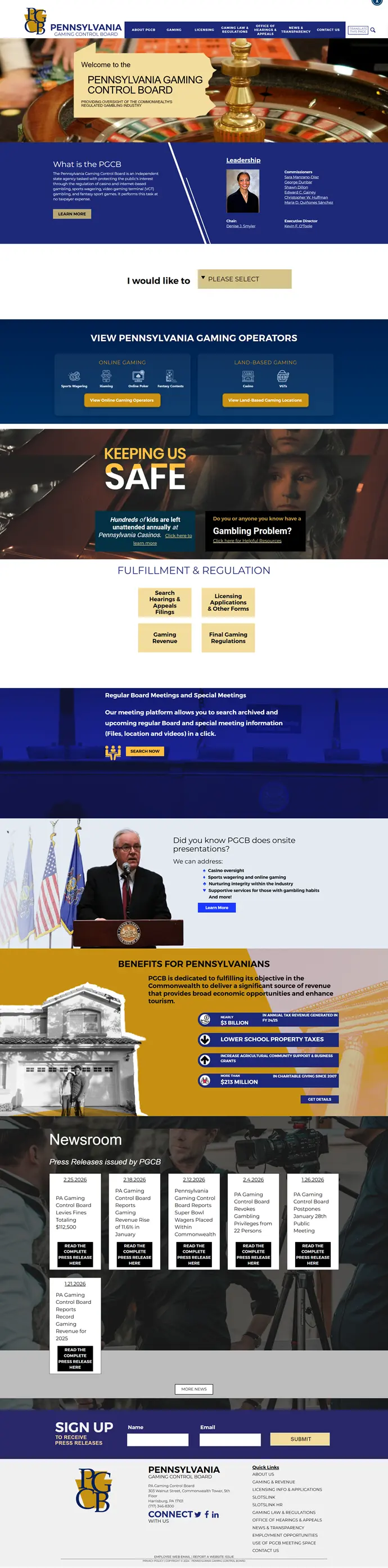
Official website of the Pennsylvania Gaming Control Board
In 2019, Pennsylvania is the second regulated state. It already stands out as one of the most promising iGaming markets in the United States. This is due both to its size, its historical maturity in terms of gambling, and the strength of its legal framework.
With nearly 13 million residents, the state ranks among the most populous in the country. However, population size alone does not explain the strong interest shown by industry players. Pennsylvania above all benefits from an audience already accustomed to regulated gambling. Its land-based offering, which is dense and long-established, clearly demonstrates this through its presence across the entire territory.
Physical casinos are well established, well attended, and integrated into the local economic landscape. This reality naturally facilitates the transition to online gambling. For players, digital casino gaming does not appear as a break, but rather as a logical extension of a world they already know.
The structural strengths of the Pennsylvania market in 2019:
A large and relatively economically homogeneous population
A solid network of already regulated land-based casinos
A gambling culture deeply rooted in local habits
Added to this is a decisive factor. Pennsylvania is the second U.S. state to implement a complete legal framework for online casinos. This pioneering position, just after New Jersey, immediately attracts international gambling software providers. They seek to secure their presence in the most credible regulated markets.
For NetEnt, this situation creates a strategic opportunity. Being present from the opening allows the company to establish itself sustainably in a state expected to generate significant volumes, well above those of smaller or more recent markets.
A competitive environment that is still being structured and not yet saturated
Pennsylvania also plays a regulatory benchmark role. Decisions taken by the PGCB are closely monitored by other U.S. states still hesitant to take the step into iGaming. A successful launch in Pennsylvania can serve as a model and accelerate the opening of other jurisdictions.
In this context, providers such as NetEnt are not only seeking immediate revenue. They aim to build legitimacy on the U.S. market by aligning themselves with the most demanding standards. A presence in Pennsylvania sends a strong signal: that of an operator capable of functioning within a complex and strict regulated environment.
What Pennsylvania represents for NetEnt in 2019:
A priority market, not a secondary test
A credibility lever with American regulators
A strategic entry point towards other regulated states
An opportunity to deploy premium casino games within a controlled framework
In 2019, Pennsylvania therefore appears as a market that is both demanding and promising. For NetEnt, obtaining a conditional license in this state amounts to laying a cornerstone in an American strategy still under construction, but already clearly oriented towards the most solid markets.
NetEnt anticipates the market opening
In March 2019, uncertainty remains: the Pennsylvania Gaming Control Board has not yet announced an official opening date for the iGaming market. This lack of a clear timeline does not prevent NetEnt from moving forward. Quite the opposite. The supplier adopts a posture of full anticipation, considering that the real challenge lies not on opening day, but in the preparation carried out beforehand.
In a regulated market such as Pennsylvania, the opening is never an improvised starting point. The operators and suppliers who succeed are those who arrive with products that are already integrated, certified, and ready to be operated immediately. NetEnt clearly chooses this approach.
From the moment it obtains its conditional license, the studio indicates that it has already concluded several agreements with American gambling operators. These partnerships are not mere commercial intentions. They involve extensive technical work, often invisible to the general public, but decisive for the success of the launch.
What “anticipating” the market opening in 2019 actually means:
Launching integration processes before the official opening
Adapting games to the specific requirements of the PGCB
Testing data, security, and compliance flows
Synchronising timelines with partner operators
Anticipation also involves adapting the products themselves. NetEnt games must meet precise criteria in terms of random generation, player protection, and session traceability. Each title is analysed, audited, and then validated before it can be offered to the public.
This phase is often long and demanding. It explains why some suppliers enter a market several months after its opening. NetEnt, on the contrary, seeks to reduce this gap to a minimum, or even eliminate it entirely.
The stakes of being present from day one:
Benefiting from maximum visibility at launch
Being included in operators’ initial offerings
Rapidly establishing its games with early players
Laying the foundations for a long-term relationship with partner platforms
This strategy is summed up clearly by Erik Nyman, Managing Director of NetEnt Americas LLC, who highlights the studio’s desire to be immediately operational:
“We are very pleased to be part of the first group of approved suppliers to run online games in Pennsylvania. This fits well with our strategy of deploying our products from the very first day of the market opening.”
In 2019, this approach places NetEnt in a position of active readiness. The studio awaits the official launch announcement, but every building block is already in place. When the signal is given by the regulator, NetEnt will not need to rush into action. It will simply activate what has already been prepared.
A key milestone in NetEnt’s U.S. expansion
In March 2019, obtaining a conditional license in Pennsylvania does not represent a simple geographic expansion for NetEnt. It fits into a methodical U.S. strategy, built state by state, with a clear priority given to the most demanding and structuring jurisdictions.
At that time, the U.S. iGaming market is still fragmented. Few states have taken the step of legalising online casino gaming. Those that have impose strict regulatory frameworks. NetEnt deliberately chooses these markets, not for ease of entry, but for their long-term strategic value.
Pennsylvania then stands out as a pivotal territory. Larger and more populous than New Jersey, it offers significant growth potential while serving as a regulatory showcase. Being authorised to operate there sends a strong signal to regulators, operators, and investors. NetEnt demonstrates its ability to meet the highest standards of the U.S. market.
The role of Pennsylvania in NetEnt’s U.S. strategy in 2019:
A priority market that is not experimental
One of the strictest regulatory environments in the United States
An opportunity for large-scale deployment
A lever of institutional credibility
This license also strengthens the position of NetEnt Americas LLC, the entity created to manage the group’s operations on U.S. soil. It allows NetEnt to centralise its regulatory processes, harmonise internal procedures, and interact directly with local authorities.
In practice, each license obtained in the United States reduces friction for subsequent ones. Audits, controls, and technical requirements are similar from one state to another, even if they are never identical. By successfully entering Pennsylvania, NetEnt accumulates valuable regulatory experience that can be reused in other emerging markets.
What this license brings to NetEnt beyond the local market:
A deeper understanding of American regulators’ expectations
Internal procedures already aligned with U.S. standards
A strong argument in negotiations with new operators
Potential acceleration of future license applications
This step must also be viewed within a competitive dynamic. In 2019, only a few international providers have the financial, technical, and human resources required to meet U.S. requirements. Being among the first to secure licenses in several states allows NetEnt to widen the gap with smaller or less structured studios.
Finally, this conditional license is not an end in itself. It marks a consolidation phase during which NetEnt strengthens its presence, tests its processes, and refines its U.S. strategy. Pennsylvania thus becomes an anchor point, a solid base from which the studio can consider further expansions, always within a controlled and regulated framework.
Why this step is decisive in 2019:
It confirms NetEnt’s intention to establish a lasting presence in the United States
It positions the studio as a credible player in the regulated market
It prepares future state openings without haste
It turns an American ambition into a concrete strategy
In March 2019, NetEnt is not yet trying to be everywhere. It focuses on being where it matters, at the right time, with the right partners, and under the most demanding rules. Pennsylvania perfectly embodies this logic.
FAQ: NetEnt license in Pennsylvania (2019)
When did NetEnt obtain its license in Pennsylvania?
NetEnt obtained a conditional license on March 20, 2019. It was granted by the Pennsylvania Gaming Control Board (PGCB) through its subsidiary NetEnt Americas LLC.
What type of license did NetEnt obtain in Pennsylvania?
It is a conditional online gaming supplier license. Its purpose is to authorise NetEnt to prepare the integration of its games ahead of the official opening of the iGaming market.
What does a conditional license mean in Pennsylvania?
A conditional license allows a supplier to be recognised as compliant by the regulator. The supplier nevertheless remains subject to additional checks before the effective launch of its games.
Why is Pennsylvania strategic for NetEnt in 2019?
Pennsylvania is the second U.S. state to regulate online casino gaming. With nearly 13 million residents, it is one of the most promising iGaming markets in the United States.
Was the Pennsylvania iGaming market already open in March 2019?
No. In March 2019, the legal framework is in place. However, the official opening date has not yet been announced by the PGCB.
Was NetEnt ready to launch its games from the market opening?
Yes. NetEnt indicated that it had already signed agreements with several American operators. The studio was preparing to be operational from day one.
Which NetEnt subsidiary is concerned by the license?
The license is granted to NetEnt Americas LLC. This entity is dedicated to the group’s operations on the U.S. market.
What is NetEnt’s strategy in the United States in 2019?
NetEnt adopts a strategy of anticipation and compliance. The game studio primarily targets the most strictly regulated markets in order to establish a long-term presence.