Summary: Key takeaways regarding the partnership between Salsa Technology and Betsoft
The partnership between Betsoft Gaming and Salsa Technology, officially announced in April 2020, takes place in a context of profound transformation within the iGaming industry. This period is marked by the rise of mobile gaming, the growing complexity of game libraries, and the need for more efficient distribution solutions.
The integration of Betsoft games into Salsa Technology’s Game Aggregation Platform forms the operational core of the agreement. It enables centralized distribution of slot games through a unified API, compatible with mobile and desktop, while preserving the visual quality and performance of the games.
Several iconic Betsoft titles, including Monster Pop™, Spring Tails™, and Total Overdrive™, are part of this integration. These games aim to strengthen the premium content offering available to Salsa Technology’s partner operators.
For Betsoft Gaming, this partnership represents a strategic B2B distribution lever, complementary to its operator agreements, allowing access to multiple markets through a single technical integration, without multiplying internal constraints.
Salsa Technology, formerly known as Patagonia Entertainment, builds on a trajectory shaped since 2012. A path marked by its initial expertise in video bingo, its early mobile shift in 2014, the acquisition of AutoGamesSYS in 2018, and its firmly established omnichannel positioning in 2020.
Salsa Technology’s technical infrastructure is based on an HTML5 architecture, native multi-language and multi-currency management, as well as high standards in terms of stability, security, and compliance. All of these aspects are reinforced by recognized certifications and licenses.
For online casino operators, this partnership results in faster deployment of Betsoft games, reduced technical complexity, and a more consistent player experience, even across large catalogs.
From the players’ perspective, the impact is indirect but tangible. It provides access to smoother, better-integrated games that remain coherent within the casino’s overall interface, without disruption between different providers.
This deliberately discreet collaboration illustrates an evolution of the iGaming model in 2020. Value no longer lies solely in game creation, but increasingly in the ability to distribute content efficiently at scale.
The partnership between Betsoft Gaming and Salsa Technology therefore stands as an example of a structuring collaboration, built on technical complementarity, stability, and a long-term vision, rather than on spectacular announcements.
Partnership between Salsa Technology and Betsoft Gaming: A strategic alliance at the heart of iGaming in 2020!
In April 2020, as iGaming is going through a phase of major technological acceleration, a discreet yet revealing partnership comes to life! Betsoft Gaming, a publisher renowned for its high-definition slot machines, joins forces with Salsa Technology. An omnichannel aggregation platform in the midst of international structuring. Behind this announcement, a deeper reality takes shape, one that builds an industry which no longer thinks about games without thinking about their distribution.
A partnership born from a profound transformation of the iGaming market
At the end of the 2010s, iGaming enters a phase of abrupt maturity. The signals are everywhere, but rarely spectacular. The player changes posture, almost without realizing it. Sessions are no longer planned; they are slipped into everyday life. Mobile entertainment establishes itself as the main entry point. Desktop play, by contrast, becomes secondary. As a whole, the experience must be immediate, fluid, without the slightest friction. This evolution does not concern only the user interface. It forces the entire ecosystem to rethink its technical and commercial foundations.
For game publishers, this period marks a delicate turning point. Betsoft Gaming has built a solid reputation thanks to slot machines with strong visual identity, featuring rich 3D animations, carefully crafted worlds, and an almost cinematic approach to gameplay. But this sophistication comes at a cost. The more graphically ambitious an online casino game becomes, the more demanding its integration is! In 2020, producing a quality title is no longer enough. One must be able to deploy it quickly, in a stable manner, across very different platforms. All of this without compromising the user experience promised to the player.
On the operators’ side, the situation becomes more complex as catalogs expand. It is no longer uncommon to see online casinos offering several hundred games, sometimes from dozens of different providers! This apparent diversity masks a much harsher reality behind the scenes. Each new provider brings its share of technical constraints, updates, and integration specificities. Very quickly, teams find themselves managing a stack of connections that slows down their capacity to innovate.
The issues most frequently mentioned at the time come back with almost worrying regularity:
integration timelines that grow longer with each new provider added,
time-consuming technical maintenance, often underestimated at the outset,
a player experience that is sometimes inconsistent between games, despite their intrinsic quality.
Faced with this accumulation of friction, awareness gradually emerges. Growth in the offer is no longer synonymous with value if it is not controlled. Aggregation platforms then cease to be perceived as simple practical tools. They become strategic infrastructures, capable of structuring chaos.
Salsa Technology fully fits into this logic. Its Game Aggregation Platform was not designed as an additional catalog, but as a normalization layer capable of simplifying exchanges between publishers and operators. By centralizing integrations, harmonizing protocols, and offering native mobile and desktop compatibility, the platform addresses very concrete needs of the current market:
reduce the time required to bring games into production,
limit technical costs linked to the multiplication of connections,
guarantee a homogeneous experience for the player, regardless of the game provider,
facilitate adaptation to local constraints, particularly linguistic and monetary ones,
allow operators to focus more on the offer and less on technical issues.
For Betsoft Gaming, the partnership with Salsa Technology then takes on an almost protective dimension. It offers a framework in which games can be distributed without being altered, without undergoing repeated technical compromises. This alliance meets several key expectations of the studio, both creative and operational:
preserve visual identity and animation fluidity,
accelerate the distribution of the catalog in strategic markets,
reduce technical friction that slows the adoption of new titles,
fit into a more controlled and more sustainable growth logic.
An industry analyst summed up the situation at the time with disarming clarity: distribution has become just as strategic as creation. A game can be excellent! However, if it arrives late with poor integration or technical degradation, it instantly loses its value!
The partnership between Salsa Technology and Betsoft Gaming is born precisely at this tipping point. It is neither an opportunistic gamble nor a simple commercial agreement. It is a thoughtful response to a market that has become denser, more demanding, and more technical. Betsoft brings strong, immediately recognizable worlds. Salsa provides the infrastructure that allows these worlds to circulate smoothly, on mobile as well as on desktop.
In this alliance, one reads not only a distribution strategy. One perceives a fine understanding of what iGaming is becoming. A growing industry where value is built as much in the quality of the game as in the way it is deployed, experienced, and perceived by the player.
The integration of Betsoft games within the Game Aggregation Platform
The integration of Betsoft games within Salsa Technology’s Game Aggregation Platform forms the operational core of the partnership! This is where the agreement moves away from intentions and enters the far more concrete realm of execution. In April 2020, this step is far from trivial. At that time, not all aggregation platforms are equal. Not all of them are capable of absorbing visually demanding content without technical compromise.
Betsoft Gaming became known for its high-definition slot machines, with rich animations, smooth transitions, and a strong graphic identity. This type of content requires an infrastructure capable of preserving visual quality while guaranteeing stable performance, particularly on mobile. Salsa Technology’s Game Aggregation Platform responds precisely to this constraint thanks to an HTML5 architecture designed for cross-platform compatibility.
Integration therefore does not simply consist of “adding games” to an existing catalog. It involves a process of normalization, adaptation, and testing so that Betsoft titles can operate homogeneously within an ecosystem already rich in providers. Several flagship games are included from the launch of the partnership, notably Monster Pop™, Spring Tails™, and Total Overdrive™. These three titles are representative of the studio’s creative foundations.
For Salsa Technology’s partner operators, this integration brings a concrete shift. It allows access to premium content without multiplying specific developments, while benefiting from a technical framework that has already been proven.
The benefits quickly translate into day-to-day platform operations:
faster game launches, thanks to the platform’s unified API,
centralized management of technical, linguistic, and monetary parameters,
immediate compatibility between mobile and desktop, without additional adaptation,
increased stability, even during traffic peaks or simultaneous updates.
But the value of the integration goes beyond operational efficiency alone. It also helps preserve the player experience, a point that is often underestimated in B2B partnerships. By going through the Game Aggregation Platform, Betsoft games retain their visual identity, animations, and pacing. All of this without suffering the degradation sometimes observed during fragmented integrations. For the player, the transition between a Betsoft game and another provider becomes smoother and more coherent.
From Betsoft Gaming’s perspective, this integration also represents a significant strategic gain. It provides a single entry point into multiple markets, without having to manage each operator or each jurisdiction separately. In a context where regulatory and technical constraints vary greatly from one country to another, this pooling becomes a decisive growth lever!
Several structuring benefits emerge from this approach:
a reduction in internal technical efforts linked to distribution,
better control over deployment timelines in new markets,
greater visibility of the catalog through a network of operators already connected to the platform,
the ability to focus more on game creation rather than on integration.
At the time, a product manager from a Latin American operator explained that this type of aggregation not only saved time, but also reduced risk. Fewer specific integrations mean fewer potential breaking points, and therefore better overall stability for the online casino.
By integrating Betsoft games within the Game Aggregation Platform,Salsa Technology does more than simply expand its catalog. The platform strengthens its credibility as an aggregator capable of hosting demanding premium content, while offering operators a turnkey solution ready to be deployed at scale.
This integration perfectly illustrates the spirit of the partnership. It does not seek to impress with numbers or spectacular announcements, but to solve real problems encountered daily by iGaming stakeholders. And it is precisely this pragmatic approach that gives the alliance betweenSalsa Technology and Betsoft Gaming its full relevance in the 2020 landscape.
Betsoft Gaming: a progressive partnership strategy in 2020
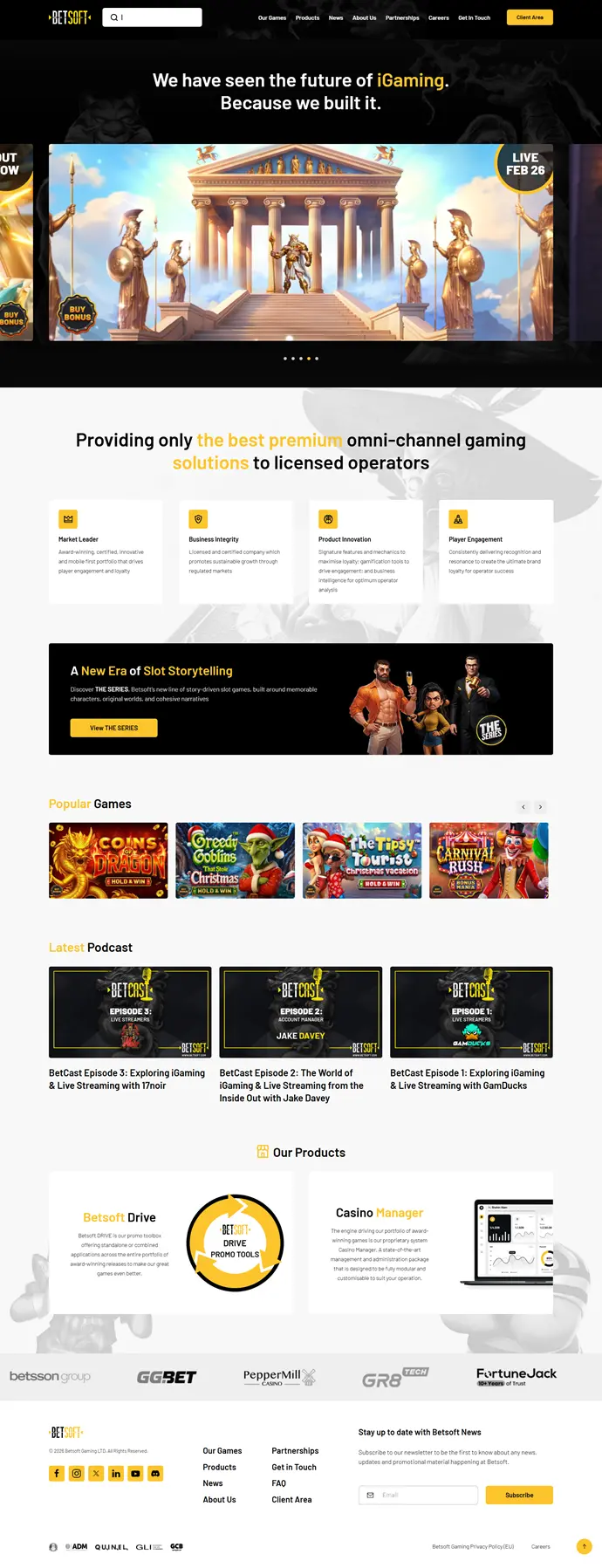
Homepage of the official Betsoft Gaming website
The year 2020 is not, for Betsoft Gaming, a sequence of isolated announcements. It looks rather like a step-by-step progression. Like a player who does not place everything on a single bet but builds an advantage move after move. Betsoft reaches a moment when the studio already has a clear identity, carried by high-definition slot machines and a strong visual approach. The question is no longer about proving content quality. The more subtle, almost strategic question is this: how can this content be circulated quickly, efficiently, and widely, without losing control of its image or getting bogged down in endless integrations?
In January 2020, Betsoft Gaming announces a partnership with the online casino Lucky Days. This type of agreement has a simple virtue. It offers a direct, tangible showcase with a mass-market-oriented operator. In an industry where visibility is a daily battle, this “player-side” presence often serves as a full-scale test. Reception is measured, behaviors are observed, and a commercial relationship is consolidated within a real operational framework.
This operator partnership addresses very concrete objectives:
increase the visibility of Betsoft games among an already active audience,
strengthen the studio’s brand awareness in a competitive environment,
anchor the brand within a logic of direct and controlled distribution.
A few months later, in April 2020, Betsoft makes a complementary move with Salsa Technology. Here, the scale and the logic change. The agreement is no longer centered on a single showcase, but on a B2B distribution lever through the integration of Betsoft games into Salsa’s Game Aggregation Platform! In other words, Betsoft is no longer just trying to be seen. Its ambition is to be deployed, replicated, and distributed smoothly across multiple markets. This is done through an infrastructure that is already in place, particularly in regions where Salsa is strongly established.
This second type of partnership follows a different, more “industrial” logic, bringing several structuring benefits:
reduce dependence on specific integrations operator by operator,
accelerate the availability of games in new markets through a single entry point,
facilitate technical management thanks to an aggregation logic and a unified API,
maintain a coherent user experience on mobile and desktop,
strengthen presence in targeted markets such as Latin America, Spain, and Portugal, where Salsa is already a reference player.
What makes Betsoft’s strategy interesting in 2020 is precisely this controlled alternation. On one side, direct presence with a mass-market operator like Lucky Days. On the other, distribution expansion via an aggregation platform such as Salsa Technology. This is not dispersion but the result of deliberate construction. As if Betsoft were placing its chips on two different squares, not to “try its luck,” but to secure a trajectory: visibility on one side, scalability on the other.
And behind this approach, one can read a very accurate intuition about iGaming in 2020. Premium content is no longer enough if it remains confined to isolated integrations. But technology alone is not enough either if it does not carry games capable of appealing to players. By multiplying complementary partnerships, Betsoft Gaming seems to have understood that growth does not hinge on a spectacular announcement. It is shaped through a progressive, almost methodical strategy, where each alliance serves a precise objective.
Salsa Technology: from a bingo specialist to an omnichannel platform
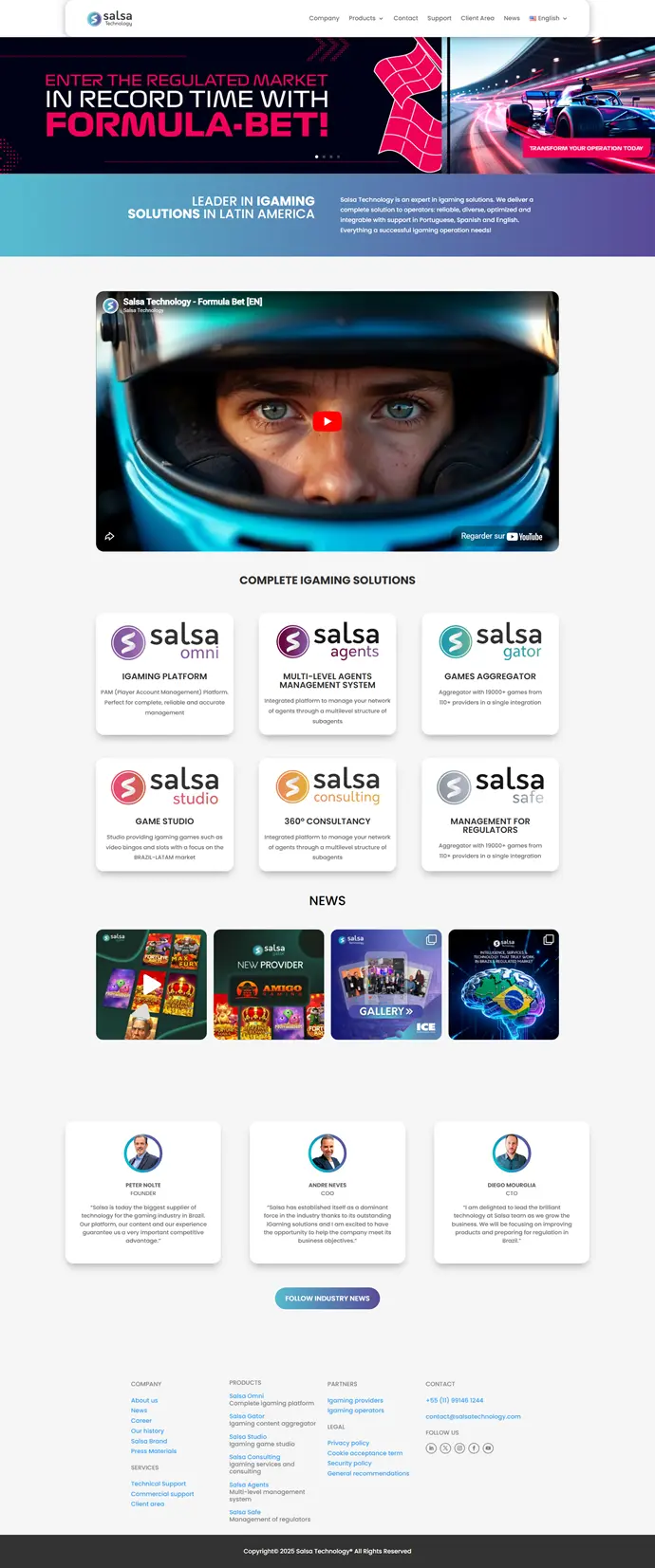
Homepage of the official Salsa Technology website
The history of Salsa Technology is not that of a player born “global” or omnichannel by nature. It begins in a far more modest way, within a specific segment of iGaming: video bingo. Founded in 2012 under the name Patagonia Entertainment, the company initially anchors itself in a Latin American market where bingo holds a strong cultural position, far more emotional than certain standardized slot machines.
This initial positioning is not insignificant. Video bingo already imposed specific constraints at the time. Managing large volumes of simultaneous players, community mechanics, and clear, readable interfaces across different devices. Without yet realizing it, Patagonia Entertainment was laying the first building blocks of what would later become an omnichannel approach. Bingo forces one to think about the experience beyond the game itself, as a complete environment.
From 2014 onward, the company initiates a decisive shift. Mobile stops being a secondary channel and becomes a development priority. Where some players struggle to adapt their existing games, Patagonia chooses to optimize its content from the design stage. This period marks a profound change in the company’s product culture. It is no longer just about creating attractive games, but about making them accessible everywhere, immediately, and without breaks in the experience.
This mobile shift leads to several structuring evolutions:
the gradual adoption of HTML5 as a technical standard,
a redesign of interfaces for smaller screens,
increased focus on fluidity and loading times,
consideration of shorter, more fragmented usage patterns.
But Salsa Technology does not limit itself to simply modernizing its catalog. In 2016, the company begins integrating third-party providers into its offering. This is a pivotal moment. It ceases to be only a game publisher and becomes a content orchestrator. This transition is neither immediate nor spectacular, but it reflects a strong intuition. The future of iGaming will not be decided solely by creation, but by the ability to efficiently connect different universes.
The acquisition of AutoGamesSYS in 2018 abruptly accelerates this transformation. With this platform, Patagonia Entertainment crosses a threshold. It no longer offers only games, but a complete infrastructure capable of managing slot machines, video bingo, casino games, and virtual content within a single technical environment. Omnichannel stops being a marketing concept and becomes an operational reality.
At this stage, several pillars already structure what will become the Game Aggregation Platform:
a unified API to connect providers and operators,
native mobile and desktop compatibility,
centralized management of multi-language and multi-currency,
an aggregation logic designed to reduce technical complexity on the operator side,
particular attention paid to stability and security.
The 2020 rebranding, with the abandonment of the name Patagonia Entertainment in favor of Salsa Technology, crystallizes this evolution. It is not a simple cosmetic change. The new name reflects a broader ambition: integrating Latin American culture into a global vision of iGaming, while fully embracing a role as a technology platform. Salsa is no longer defined by a type of game, but by its ability to make diverse content interact within a single ecosystem.
A Latin American market analyst summarized this trajectory well by explaining that Salsa Technology did not try to skip steps. Each pivot relied on an existing competence. Bingo taught community management. Mobile imposed technical lightness. Aggregation structured the whole. This progression through successive layers explains why, in 2020, Salsa Technology appears as a credible partner for demanding publishers such as Betsoft Gaming.
This journey also provides an essential key to understanding the partnership. Betsoft does not associate with an opportunistic platform, but with a player whose omnichannel capability is the result of a decade of adjustments, technical choices, and a fine understanding of player usage. In a market where many promise omnichannel, few can explain how they actually achieved it.
A technical infrastructure designed for scalability
When we talk about scalability in iGaming, it is not just about being able to “add more games”. The term is often overused. In reality, it refers to a platform’s ability to absorb growth without losing balance, to take on new providers, new markets, new volumes of players, without degrading either performance or the user experience. This is precisely where Salsa Technology’s infrastructure makes the difference!
Salsa’s Game Aggregation Platform was not designed as a makeshift layer patched together through partnerships. It is built on an architecture conceived from the outset to centralize, normalize, and redistribute. The unified API plays a key role here. It acts as a common language between publishers with sometimes very different logics and operators subject to multiple technical and regulatory constraints. This structural choice helps avoid the stacking of specific solutions, which are often a source of slowdowns and bugs in the medium term.
On an operational level, this approach translates into very concrete benefits for operators, which are not always visible on the player side, but which nevertheless condition the quality of the experience:
faster integration of providers, with fewer manual interventions,
simplified maintenance thanks to normalization of technical flows,
better management of simultaneous updates across multiple games,
a reduction in potential breaking points during traffic peaks.
Native mobile and desktop compatibility is another essential pillar of this scalability. By relying on HTML5, Salsa Technology ensures that integrated games, including those from Betsoft Gaming, retain their performance across very diverse environments. This point is far from anecdotal. In 2020, a growing share of gaming sessions takes place on mobile, often under uneven network conditions. A scalable infrastructure must therefore be able to maintain a smooth experience, even in constrained contexts.
This technical requirement extends into multi-language and multi-currency management. Here again, scalability is not reduced to an option activated in a menu. It implies a global platform design capable of automatically adapting parameters according to the target market. For an operator active across multiple jurisdictions, this centralization represents a considerable time saving and limits the risk of operational errors.
Several structuring elements further reinforce this ability to scale up without losing control:
an architecture designed to support a high volume of simultaneous players,
security mechanisms integrated from the design stage,
collaboration with independent laboratories such as GLI to guarantee compliance,
a modular approach allowing providers to be added or removed without disrupting the whole.
A technical manager from a Latin American operator explained that this type of infrastructure profoundly changes the way an online casino is managed. Where each new provider previously represented a risk and an additional burden, aggregation now makes it possible to absorb growth in a calmer, almost mechanical way.
Within the framework of the partnership with Betsoft Gaming, this infrastructure takes on an additional strategic dimension. The studio’s slot machines, known for their 3D animations and visual richness, require an environment capable of supporting this level of demand without compromise. Salsa Technology’s platform offers precisely this framework. It allows Betsoft games to preserve their identity while being distributed at scale.
In the end, this infrastructure does not seek to impress with abstract promises. It stands out through its ability to hold up over time. In a sector where many platforms struggle to keep pace with their own growth, scalability becomes a factor of trust. And it is often this invisible, yet decisive, criterion that makes the difference between a one-off alliance and a truly structuring partnership.
A partnership revealing the dynamics of iGaming in 2020
The partnership between Salsa Technology and Betsoft Gaming cannot be read as a simple rapprochement between a publisher and a platform. It acts rather as a faithful mirror of the tensions and transformations running through iGaming in 2020. The industry has reached a point where the rapid growth of previous years is beginning to show its limits. Catalogs are vast, sometimes bloated, but the ability to exploit them efficiently becomes a far more complex challenge than it may seem!
In 2020, several dynamics overlap. First, a clear acceleration of mobile, which is no longer a trend but a dominant reality. Players expect online games to be immediately accessible, with no visual compromise, even on smaller screens. This requirement puts pressure on publishers, but also on platforms, which must guarantee consistent performance across highly variable technical environments.
Added to this is a densification of the offer. Operators no longer compete solely on the number of games available, but on their ability to structure their catalog. Too many titles kills readability. Too many providers kills agility. Many then realize that differentiation no longer comes only from accumulation, but from overall coherence.
In this context, several major challenges clearly emerge for market players:
the need to reduce time to market for new games,
the importance of delivering a homogeneous experience despite provider diversity,
the growing role of aggregation platforms as a structural solution,
the search for balance between premium content and robust infrastructure.
The partnership between Salsa Technology and Betsoft Gaming fits precisely into this search for balance. Betsoft represents a publisher with a strong identity, capable of producing slot machines that are immediately recognizable, yet constrained by the limits of fragmented distribution. Salsa Technology, by contrast, embodies a platform whose value lies in its ability to connect, normalize, and distribute diverse content without multiplying specific integrations.
Another key factor in 2020 lies in market geography. Latin America, Spain, and Portugal emerge as high-potential regions, but also as markets with specific constraints, both technical and regulatory. For international publishers, entering these territories without a local or regional partner becomes increasingly complex. Salsa Technology, already established in these markets, offers Betsoft a structured access, avoiding a fragmented and costly approach.
In 2020, one can also observe increased professionalization of B2B iGaming. Partnerships become more selective and less opportunistic. Publishers look for platforms capable of supporting their growth over the long term, while aggregators favor content that can strengthen their credibility. Within this logic, the alliance between Salsa and Betsoft appears as a rational, almost obvious choice, rather than a risky bet.
An iGaming consultant summarized this period with a simple phrase: the market has entered a phase where technology must no longer draw attention to itself. It must work. Invisibly. This expectation explains why the most relevant partnerships of 2020 are often those that make the least noise, yet respond to very concrete needs.
Finally, this partnership highlights a more subtle but decisive evolution: the redistribution of value in iGaming. In 2020, value is no longer concentrated solely on game creation or player acquisition. It shifts toward the ability to orchestrate the whole, to make content circulate in a fluid, secure, and scalable way.
Through the alliance betweenSalsa Technology and Betsoft Gaming, this new hierarchy becomes clearly visible. The game remains central, of course. But it is now the quality of infrastructure and distribution that conditions its success. And this is precisely why this partnership goes far beyond the scope of a one-off agreement. It tells, on its own, the story of iGaming in 2020.
A discreet but structuring collaboration
What first stands out in the partnership between Salsa Technology and Betsoft Gaming is the absence of excessive staging. No flashy promises, no figures brandished like trophies, and no triumphalist discourse either. And it is precisely this relative silence that says a great deal. In 2020, in a sector where every novelty is often announced as a revolution, this restraint stands out. It reveals a collaboration designed to last rather than to make noise.
This discretion is not a lack of ambition. It is the symptom of a partnership built on solid technical and operational foundations, rather than on publicity effects. Betsoft Gaming does not seek to multiply press releases in order to exist. The studio already knows its value. Salsa Technology, for its part, does not need to overplay its role. Its value is measured in the ability of its platform to function, to absorb complexity, and to hold under load.
In practice, this collaboration acts as an invisible binder within the iGaming ecosystem. It does not overturn player habits overnight, but it deeply modifies the way content circulates between publishers and operators. The effects are progressive, sometimes imperceptible, but cumulative. Fewer technical frictions. Shorter time-to-market. Better overall coherence of the offer.
For operators, this approach translates into benefits that do not always make headlines, but that matter over time:
smoother game integration, without overloading technical teams,
increased platform stability, even when adding new providers,
the ability to enrich the catalog without questioning the existing architecture,
a more homogeneous player experience, less marked by differences between providers.
On Betsoft Gaming’s side, this collaboration makes it possible to fit into a logic of controlled growth. The studio does not have to sacrifice its visual identity or its creative ambitions in order to adapt to disparate technical constraints. Salsa’s platform plays here a filtering, even protective role, by ensuring that the games retain their integrity. This, regardless of how they are distributed.
A product manager mentioned in this regard a simple but essential idea: the best partnerships are those that are not immediately noticeable, because they work. When everything is fluid, when nothing breaks, when the player does not perceive the complexity in the background, it is often a sign that the infrastructure is well designed and that the collaboration is healthy.
This alliance also illustrates a form of maturity in B2B iGaming. In 2020, the strongest players understand that value is not created solely through constant novelty, but through repeated reliability. Each game that launches without incident, each update that goes unnoticed, each market added without disrupting the whole strengthens the credibility of the model.
Finally, this collaboration is discreet and structuring because it is rooted in the long term. It does not depend on a one-off success or a flagship game. It relies on an architecture capable of welcoming new content, new partners, new regulatory requirements, without calling into question what has already been built. In a sector as dynamic as iGaming, this ability to endure is often more valuable than spectacular short-term growth.
Ultimately, the partnership between Salsa Technology and Betsoft Gaming does not aim to redefine the industry through grand announcements. It contributes, more humbly but more durably, to structuring its foundations. And it is often in this deliberate discretion that the most decisive collaborations are found.
FAQ: Understanding the partnership between Betsoft Gaming and Salsa Technology
Why does this partnership take place specifically in 2020 and not earlier?
The year 2020 marks a point of convergence between several developments that were already underway. Mobile casino gaming has become the main entry point for a large share of players. Game catalogs have reached a critical size, not to mention operators who can no longer afford long and costly integrations. Betsoft Gaming reaches creative maturity, while Salsa Technology has already consolidated its omnichannel infrastructure. This partnership is therefore not opportunistic. It takes place at the exact moment when the market is ready to absorb this type of technical alliance without friction.
What does this partnership change for Betsoft Gaming on an operational level?
For Betsoft, integration into Salsa Technology’s Game Aggregation Platform represents a profound change in the way its gambling games are distributed. Instead of managing a multiplication of specific integrations with each operator, the studio benefits from a centralized access point. This makes it possible to reduce internal technical workload, shorten deployment cycles, and better control the final quality of the games as they are delivered to players, on mobile as well as on desktop.
How is the Game Aggregation Platform suited to Betsoft’s visually demanding games?
Betsoft’s video slot machines are known for their animations, transitions, and strong graphic identity. This type of content can quickly lose quality if it is poorly integrated or poorly optimized. Salsa Technology’s platform is based on an HTML5 architecture designed to preserve performance and fluidity, even on mobile devices or less stable networks. This native compatibility avoids the visual degradation often observed during fragmented integrations.
What concrete benefits do operators gain from this partnership?
For operators, this partnership translates into a tangible simplification of daily operations. Access to Betsoft games through Salsa Technology’s platform enables faster go-live, centralized maintenance, and better overall catalog consistency. The operator does not need to reinvent integration for each publisher. As a result, this limits technical risks and improves the long-term stability of the gaming environment.
Does this partnership have a visible impact for end players?
The impact is rarely spectacular, but it is real! Players benefit from a smoother experience, with gambling games that load properly, retain their graphic quality, and integrate coherently into the casino interface. Technical complexity disappears from their field of vision. And in iGaming, this invisibility is often a sign of a well-designed infrastructure.
Why is Salsa Technology a credible partner for a publisher like Betsoft?
Salsa Technology is not an improvised aggregator. Its journey, from video bingo to an omnichannel platform, has allowed it to acquire a fine understanding of player usage and operator constraints. For Betsoft, relying on such a platform means working with a partner capable of absorbing complexity without passing it on to the game itself. This technical credibility is essential when content relies heavily on visual experience.
Does this partnership reflect an evolution in the role of aggregation platforms?
Yes, very clearly. In 2020, aggregation platforms are no longer simple intermediaries. They become structuring players within the iGaming ecosystem. The partnership between Betsoft and Salsa illustrates this evolution: the aggregator does not merely distribute, as it guarantees coherence, stability, and scalability of content. Value shifts toward this ability to orchestrate the whole.
Can it be said that this partnership prioritizes stability over rapid growth?
To a certain extent, yes. The partnership does not rely on spectacular announcements or quantified promises. It fits into a logic of progressive construction, where technical stability and operational reliability take precedence over pure speed. This approach corresponds to a phase of market maturity, where players seek to secure their foundations rather than multiply headline-grabbing moves.
Is this type of collaboration likely to become the norm in iGaming?
Without generalizing, this partnership offers a very realistic preview. As catalogs expand and markets become more complex, publishers and operators need partners capable of simplifying, not adding complexity. Alliances based on technical complementarity and operational discretion are increasingly valued, even if they often remain in the background.
What does this partnership reveal about Betsoft Gaming’s long-term vision?
It shows that Betsoft Gaming is not only seeking to produce attractive games, but to embed them within a sustainable distribution model. By choosing Salsa Technology, the studio prioritizes an infrastructure capable of supporting its growth without compromising its creative identity. It is a pragmatic, long-term-oriented vision that reflects a fine understanding of the new rules of modern iGaming.