Payr is a British payment facilitator dedicated to paying rent by credit or debit card.
Operated by Payr LTD, a company registered in England (no. 14941240), with its head office in Covent Garden, London.
Exact category: payment gateway, and not an e-wallet, prepaid card, mobile payment or cryptocurrency.
How it works, and the cards
Three steps: enter your tenancy details, register your card, confirm the payment.
Accepted networks: Visa, Mastercard and American Express.
The central selling point:earning your card's loyalty points on rent, a spend that is normally ineligible.
The landlord is paid the same day, with no sign-up needed on their side.
Regulatory framework
Payr is not authorised in its own right by the Financial Conduct Authority.
It relies on Moorwand (an electronic money institution) to move the funds.
It relies on Ryft (a payment institution authorised by the FCA, no. 972895, certified PCI DSS Level 1) to process the transactions.
Security: 3D Secure, SSL and TLS encryption, fraud detection; GDPR compliance under ICO oversight.
Cost
A commission of 1.99% per transaction.
That is £19 on a monthly rent of £1,000, around £240 over the year.
Profitability is conditional: it only works if the value of the rewards beats the fees.
Structural limits
A UK-only service, denominated in pounds sterling alone.
Irreversible payments: no direct refund possible from Payr.
Single-purpose use, contractually restricted to rent payment.
Payr and online casinos
No regulated casino accepts Payr to deposit or withdraw money.
Contractual lock: the terms explicitly forbid any use outside renting.
Monetary and geographic lock: one currency, one market, unusable elsewhere.
Structural lock: no integration possible on the casino side, by design.
Online "Payr casino" lists are generated automatically by comparison sites and rest on no reality at all.
Putting it in perspective
Gateways genuinely tied to casinos: Pay N Play (Trustly), for Sweden, Germany, Finland, Estonia and the Netherlands.
Other payment fintechs: kevin. (merchant A2A collection) and Payoro (B2B mass payouts), unrelated to gaming deposits.
On Kynox, the CASINO filter applied to Payr returns no operator: that is the expected result, not a gap.
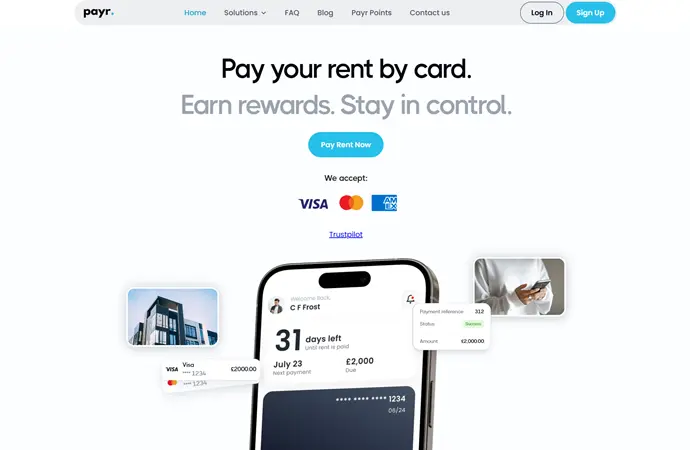
Payr's homepage states its promise plainly: pay your rent by card and earn rewards. The Visa, Mastercard and American Express logos confirm the three accepted networks, while the mobile interface shows a tenant account, a world away from any casino cashier.
Payr and online casinos: the truth about a payment method that isn't one
Type "casinos that accept Payr" into a search engine and you'll land on whole pages of supposedly compatible operators, bonuses in tow, flattering scores out of 172, all served with the calm confidence of verified information. The trouble is that this information doesn't survive three minutes spent reading Payr's official documents. Behind the name sits a service whose business has nothing to do with online gambling. Worse, it even forbids the very use people attribute to it. Here is what Payr really is, and why you'll never see it at the cashier of a serious regulated online casino.
So what exactly is Payr?
Payr is the trading name of Payr LTD, a company registered in England under number 14941240, with its head office at 71-75 Shelton Street, in Covent Garden, right in the heart of London. Its purpose fits into a single sentence that leaves no room for interpretation: letting a tenant pay rent to their landlord with a credit or debit card.
That's it. No gaming account to top up, no winnings to collect, no blackjack table in sight. The customer is the tenant who wants to pay rent by something other than a standard bank transfer. The target is the British rental market. The benefit sold to the user comes down to a rather clever idea: turning a household's biggest monthly expense into a source of points, air miles or cashback, through the loyalty programmes attached to a bank card.
This is the polar opposite of a gambling tool. Where an online casino asks you to inject money in order to bet, Payr pushes your money out towards a landlord. The direction the funds travel, on its own, should be enough to kill the confusion.
Which payment category does it belong to?
The question of category deserves a pause, because this is exactly where the fake fact sheets go off the rails. Payr is neither an e-wallet, nor a prepaid card, nor a mobile payment method in the Apple Pay or Google Pay sense, nor of course a cryptocurrency like BTC.
Technically, Payr falls under payment gateways, or more precisely payment facilitators. The company doesn't store a balance for you. It doesn't issue you a card. It doesn't open a top-up wallet. It charges the amount to your card, adds its commission, then routes the sum to the landlord's account. It's plumbing, not a vault.
A detail that matters for judging how serious it is, and one the comparison sites keep quiet about: Payr is not itself authorised by the Financial Conduct Authority, the British financial regulator. So it cannot provide payment services in its own name. To operate legally, it leans on two genuinely regulated institutions. On one side, Moorwand Ltd, authorised as an electronic money institution, which issues the e-money and physically carries out the payments. On the other, Ryft, the trading name of Butlr Ltd, authorised by the FCA as a payment institution under number 972895 and certified PCI DSS Level 1, the highest standard for banking data security. When you pay "with Payr", it is really Moorwand moving the funds and Ryft processing the transaction. Payr is the interface and the brand, in no way the financial operator.
What a real payment gateway is, and what Payr isn't quite
To gauge Payr's place properly, you first need to know what a payment gateway worthy of the name looks like. The term gets overused, slapped on more or less everywhere, until it ends up meaning nothing. A few concrete examples help clear the air. They also explain why Payr occupies a far narrower niche than people think.
Three gateways, three philosophies
Take kevin., a Lithuanian fintech founded in Vilnius in 2018. Its business is account-to-account payment infrastructure via open banking: letting a merchant collect a bank transfer directly, without going through the card networks, so at lower cost. It's technical plumbing sold to retailers. It gained real traction in Europe before hitting a major snag. In the summer of 2024, the Lithuanian central bank ordered it to stop taking on new clients for audit reasons. The example is instructive on two counts. It shows what an A2A gateway is, and it's a reminder that no fintech, however promising, escapes the regulator's eye.
Take Payoro next, a Canadian company registered with the Bank of Canada and FINTRAC. Here we switch registers. Payoro is a mass payout infrastructure. It's an API that automates sending payments to customers, freelancers or partners worldwide, handling both standard currencies and cryptocurrencies. Payoro is a B2B payout tool, built for platforms that need to disburse money at scale. The opposite of a consumer instrument you'd reach for to settle a personal expense.
Take Pay N Play last. Here we touch the only one of the three that genuinely belongs to the casino world. Developed by Sweden's Trustly and unveiled in London in 2018, this system does more than carry money. It merges registration, KYC verification and deposit into a single action, drawing on bank identification. The player deposits with Pay N Play, plays, and withdraws winnings without ever filling in a standard registration form, while the operator stays compliant. The catch is geographic. Pay N Play only works for players in Sweden, Germany, Finland, Estonia and the Netherlands. Outside that zone, this key opens no door.
So where does Payr fit in?
Put these three players side by side and one thing jumps out. Each one moves money to serve a real, identifiable economic purpose. Merchant collection for kevin., mass payout for Payoro, gaming deposits for Pay N Play. Payr only moves money in one direction and for one reason, paying rent to a landlord. It isn't a merchant gateway. It isn't a payout infrastructure. And it certainly isn't a casino onboarding solution. It's a single-purpose facilitator, locked onto one currency and one market, whose very reason for existing rules out a gaming transaction by design. Filing it in the same sentence as Pay N Play, without this clarification, would lend it a kinship it doesn't have. The nuance isn't cosmetic. It's the whole argument.
The services Payr actually offers
The offer isn't just a "pay my rent" button. The company has structured it into several variants, each aimed at a specific profile. A quick tour, no flattery.
Paying rent by card with rewards
The heart of the engine. The user enters their tenancy details, adds the card of their choice from the three major networks (Visa, Mastercard, American Express), then pays the rent. The differentiator comes down to one word: the reward. And here's a subtlety Payr is honest enough to spell out in its terms. The company itself offers no reward and no bonus. The perks come solely from your card issuer and fall under its rules. Payr merely makes the transaction eligible for those programmes.
International payments
Designed for expats. Rather than suffer the sluggishness and hidden fees of an international transfer, the user pays their British rent with a foreign card, with Payr handling the conversion and same-day settlement. The account still stays denominated in pounds sterling, and the exchange rate depends on your issuer, plus a conversion margin detailed on the site.
The offer for businesses
Paying commercial rent by card to protect short-term cash flow, free up liquidity, and access your invoices on the platform for accounting. Payr positions it as a cheaper alternative to a short-term loan. The argument holds for a director managing a cash-flow gap, provided the commission stays below the cost of conventional financing.
Large-scale rent collection and multi-property management
Under the "built-to-rent" label, Payr acts as a card payment collection agent for large property portfolio managers, at no cost to them, the saving lying in the usual processing fees. For short-term rental operators, a single dashboard centralises the rents from several properties, with discounts on high-volume payments. Purely administrative use: centralise, simplify, synchronise.
Payr Points, the loyalty programme to come
Payr announces an in-house programme, still at the "coming soon" stage when this data was collected: earn points on every rent payment, refer friends, unlock rewards. A programme that doesn't exist yet remains a promise, not a service. We mention it for what it is: an intention.
How a transaction unfolds, and what that reveals
The journey comes in three steps. You enter your tenancy details, you register your card, you confirm, and Payr passes the funds to the landlord the same day.
Under the hood, the process is more demanding than it looks, and that's to its credit. Opening an account requires full identity verification: proof of address, ID document, passport, photograph, nationality, and even salary. Payr reserves the right to ask at any time for proof of where the funds come from, and to suspend access until its compliance team has validated the documents. The account is denominated in pounds sterling only. No payment can be scheduled in advance, and once the funds are transferred, the operation is irreversible. No refund is possible between you and Payr. Any dispute must be settled with the landlord.
This locked-down architecture tells a story. It isn't the profile of an instrument built for the smoothness of a casino deposit, where you want your account credited in seconds. No, it's the profile of a regulated payment rail, slow by design, cut out for a heavy, traceable transaction the way rent is.
How much does Payr cost?
The service isn't free, and that's its Achilles' heel. Payr takes a commission of 1.99% on each transaction. In plain terms, a monthly rent of £1,000 costs you £19 in fees, and paying twelve months of rent this way comes to around £240 over the year, more if your rent climbs. Users who count their pennies know it. The move only makes sense if the value of the points earned beats this levy. The savviest don't use it continuously anyway, but now and then, to hit the sign-up bonus thresholds on certain cards they couldn't unlock otherwise. Which tells you how far profitability is from automatic. It's case by case.
Security and compliance, what Payr is really worth
On the security front, Payr doesn't bluff, and that deserves acknowledging. The service stacks up the protections expected of a serious player: 3D Secure authentication, SSL and TLS encryption, fraud detection and prevention systems. The link with Ryft, certified PCI DSS Level 1, guarantees that card data travels through an environment meeting the industry's strictest standards. On personal data, Payr LTD presents itself as a data controller under UK GDPR, subject to oversight by the Information Commissioner's Office, with a detailed privacy policy.
The one serious reservation, and it counts, remains the absence of FCA authorisation in its own right. Payr depends entirely on its regulated partners to exist legally. This isn't illegal, since it's a common setup among young fintechs. Still, it means your legal protection rests on Moorwand and Ryft, not on Payr itself. A well-informed user should know this.
Payr and online casinos, why this payment method has no place at the cashier
Here we reach the heart of the matter, and this is where everything tips over. No player can legitimately deposit or withdraw money at a regulated casino with Payr. Not because the service is too obscure or too new. Because it's contractually forbidden, technically impossible, and geographically absurd. Three locks, which we'll examine one by one.
An explicit contractual lock
The ban is written in black and white in the terms and conditions. The user undertakes to use their account only for rent payment, and for no other purpose. Payr explicitly reserves the right to refuse any payment it judges unconnected to rent paid to a landlord. Using the individual account for trading or commercial ends is prohibited. The entire compliance layer, enhanced identity checks, anti-money-laundering controls, requests for proof of where the funds come from, is calibrated to spot and block flows foreign to renting. Trying to pass off a casino deposit as rent would lead, at best, to a flat refusal. At worst, to an account block for fraudulent use.
A monetary and geographic lock
Payr works exclusively in pounds sterling, on the British rental market alone. French, Spanish or other readers couldn't use it for a deposit in their own jurisdiction anyway, since neither the currency nor the service's coverage allows it. The product is single-market by design.
A structural lock on the casino side
A regulated casino integrates its payment methods through approved aggregators, which are subject to their own compliance rules. None of them has the slightest reason, or the slightest means, to list at its cashier a rent payment facilitator that refuses gaming transactions on principle. The two worlds cross nowhere. There is no technical integration, because there can't be one.
The comparison-site mirage, how fake "Payr casino" lists are born
One fair question remains. If Payr has nothing to do with casinos, where do these web pages listing a dozen operators proudly accepting the method come from? The answer is less flattering than you'd hope, and it says a lot about the state of SEO in our sector.
These lists are manufactured by automated content farms. Some comparison sites mechanically generate one page per payment method, drawing from an internal dictionary of hundreds of options, then cross-referencing that list with their casino database, without ever checking that an operator actually offers the method. The result is an empty shell dressed up as an editorial fact sheet.
The signs of this industrialisation jump out. On one of these pages, the categories tied to Payr line up at random: UzCard, 7-Eleven, Bitcoin SV, SMS Voucher, BankID, Kassa 24. Regional payment methods with nothing in common. That's the signature of a mesh laid down by an algorithm, not by a writer worthy of the name. The casinos listed, often stamped Aspire Global International or Elec Games and all created in 2025, are operators that accept dozens of methods through their aggregators. So seeing them surface under the Payr label proves nothing beyond the passage of a generator. Better still: on one of these sites, the casino rated 172 out of 172, the maximum score, links to an empty anchor that leads nowhere. The comparison site cites itself on a loop, with no substance behind it. These sites also claim to be "AI-verified", a phrase that sounds like a quality stamp but mainly denotes content churned out on an assembly line.
Payr's strengths and weaknesses, in its real field
To be fair, you have to judge this service on its own turf. Rent payment, not an online casino use it doesn't claim.
On the strengths side, Payr solves a real problem. Turning rent into a points generator is clever for anyone juggling a rewards card. Same-day settlement, without forcing the landlord to sign up, removes a real friction. Support for international cards helps expats. The security arsenal, 3D Secure, encryption, a PCI DSS Level 1 certified partner, is solid. And the transparency about where the rewards come from, your bank and not Payr, shows a commercial honesty you don't always come across.
On the weaknesses side, the 1.99% commission is the central sticking point. The maths only turns profitable if the value of the points beats the fees, which is anything but automatic and pushes shrewd users towards occasional rather than regular use. The service is confined to the pound sterling and the British market alone, so it's unusable elsewhere. The lack of FCA authorisation in its own right places user protection on third parties. The irreversible nature of payments demands flawless care at the moment of entry. Finally, the scope of use is narrow by design: a single-purpose tool, all the better for clarity, all the worse for versatility.
Should you look for Payr at a casino cashier?
If you landed on this page looking for an online casino that accepts Payr to deposit or withdraw your winnings, the honest answer is that there isn't one, and there couldn't be. The real Payr is a London-based rent payment facilitator. It's locked onto the pound sterling and backed by Moorwand and Ryft. Its terms explicitly forbid any use foreign to renting. The contrary lists doing the rounds are artefacts of automatic generators, empty labels pinned to casinos that never offered this service.
On Kynox, the geolocated CASINO filter applied to Payr will therefore return no operator, and that's the expected result. This absence isn't a shortcoming. It's confirmation that reality has been respected. To fund your gaming account within the legal framework of your jurisdiction, turn to the instruments genuinely integrated into regulated casinos. For instance: standard bank cards, recognised e-wallets, bank transfers or authentic mobile payment solutions. And leave Payr to what it does best: paying rent.
FAQ: Payr
Can you deposit at an online casino with Payr?
No, no regulated online casino accepts Payr to deposit or withdraw money. Payr is a British rent payment service by card, whose terms of use explicitly forbid any use unrelated to renting. The service refuses, on principle, any transaction that doesn't correspond to paying rent to a landlord.
What is Payr?
Payr is a British payment facilitator that lets a tenant pay their rent by credit or debit card. Operated by Payr LTD, a London company, the service adds a commission to each payment then passes the sum to the landlord, with the tenant able to earn their bank card's loyalty points along the way.
Which payment category does Payr fall into?
Payr is a payment gateway, more precisely a payment facilitator. It's neither an e-wallet, nor a prepaid card, nor a mobile payment method, nor a cryptocurrency. It stores no balance and issues no card: it merely routes a payment from the tenant's card to the landlord's account.
Is Payr regulated by the FCA?
No, Payr isn't authorised in its own right by the Financial Conduct Authority. To operate legally, it relies on two regulated institutions: Moorwand, authorised as an electronic money institution, and Ryft, a payment institution authorised by the FCA under number 972895 and certified PCI DSS Level 1.
How much does Payr cost?
Payr takes a commission of 1.99% on each transaction. For a monthly rent of £1,000, that comes to £19 in fees, or around £240 over a full year. The move is only profitable if the value of the rewards earned on the card exceeds this amount.
Which countries does Payr work in?
Payr works exclusively in the United Kingdom and only in pounds sterling. A user located in France, Spain or elsewhere cannot use it to settle an expense in their own currency or their own jurisdiction.
Why do online lists of casinos accepting Payr exist?
Because these lists are produced by automated comparison sites that create one page per payment method without checking it's real. The generator cross-references a dictionary of options with a casino database, and so manufactures a "Payr casino" page that rests on no real integration. The telltale sign: these sheets mix unrelated regional payment methods and sometimes link to empty pages.
Which payment gateways are actually used in online casinos?
The most emblematic gateway in the casino world is Pay N Play, developed by Sweden's Trustly, which merges registration, identity verification and deposit into a single step for players in Sweden, Germany, Finland, Estonia and the Netherlands. Other fintechs like kevin. or Payoro exist in the payment ecosystem, but they serve merchant collection or business-to-business mass payouts, not mainstream gaming deposits.
Which cards does Payr accept?
Payr accepts the three main networks: Visa, Mastercard and American Express. It's precisely the American Express support that appeals to users looking to earn miles or points on a spending category, rent, usually ineligible for cards.
Are payments made via Payr refundable?
No, once the funds are transferred to the landlord, the payment is irreversible and no refund is possible directly from Payr. Any dispute must be settled with the landlord or their agent; if the latter agrees to a refund, they pay it back to the tenant themselves.