Crypto fees: 1.8% for the eight main assets, no fixed rate for DAI
eVoucher fees: 4.5% to 5.5% depending on currency
Most expensive method: Paysafecard, at 10.5%
Withdrawal and verification
Withdrawal time: one to two business days on average
KYC within the EEA: proof of identity and proof of address
KYC outside the EEA: proof of identity with a selfie
"On Hold KYC" status: the payments team is reviewing the file, which can take up to 24 hours
App and access
Mobile app: free, available on the App Store and Google Play
Access security: biometric login
Industry recognition: recognised multiple times at the Paytech Awards
Where to play
Availability: depends on which operators have integrated MiFinity and on your jurisdiction of residence
Casino selection: the CASINO filter at the top of the page, showing regulated casinos compatible with MiFinity based on your location
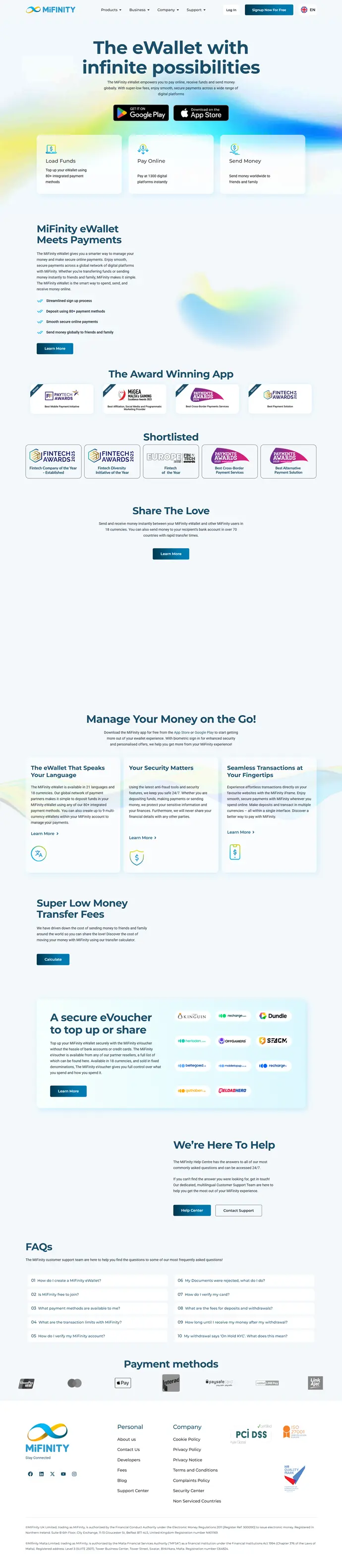
Screenshot of the official MiFinity page presenting its eWallet, payment methods, and money sending and receiving features
MiFinity: the eWallet with endless possibilities for deposits and withdrawals at regulated online casinos
"The eWallet with endless possibilities." That's how MiFinity describes itself, right there on its own website, with zero hesitation and even less modesty. Give the tagline credit for one thing: honesty. Few payment solutions dare to claim such a broad ambition. Before getting swept up in the marketing enthusiasm, let's lay out the basics that actually matter to a player. MiFinity belongs to the eWallet family, electronic wallets in other words: a digital account that centralises money, currencies, and payment methods in one place, without ever exposing the customer's banking details to the merchant site being paid.
Don't confuse MiFinity with no-registration bank-account payment solutions either. Pay N Play by Trustly, for example, runs on an entirely different open banking mechanism, with no balance and no account in the true sense. With MiFinity, the money genuinely sits inside the wallet between bets. For a player who moves between several regulated online casinos, across several currencies and sometimes several countries, this kind of tool changes things in a real way.
What remains to be seen is whether the promise holds up under a close look at its services, fees, and regulatory framework. Once that's settled, one more concrete step remains: finding, through the CASINO filter at the top of this page, exactly where to place your chips in your own jurisdiction.
MiFinity, portrait of an eWallet with a quarter century behind it
The polished interface, the award-winning app, the international ambitions worn without a hint of modesty: everything about MiFinity feels like a fresh newcomer eager to make its mark. Except the company actually claims more than 25 years of experience in online payments. That detail, and it's not a small one, places MiFinity in a sector where players reinvent themselves at breakneck speed, closer to the veterans than the newcomers. This history isn't just a nice footnote. It largely explains the solid regulatory base MiFinity has built its offering on.
Oddly, the company itself doesn't seem entirely settled on the actual size of its network. Its various communications mention anywhere from 75 to more than 80 integrated payment methods, and while the website advertises more than 1,300 partner digital platforms, its own app store listings put the number closer to 1,200 merchants. The blur is probably down to how fast the network keeps expanding quarter to quarter, but it's a reminder to trust the ballpark figure rather than the exact digit.
The company operates under two regulatory hats. MiFinity UK Limited is authorised by the UK's Financial Conduct Authority under the Electronic Money Regulations 2011, with a registered office in Belfast, Northern Ireland. MiFinity Malta Limited, for its part, holds a financial institution licence issued by the Malta Financial Services Authority under the Financial Institutions Act of 1994. Two entities, two jurisdictions, one stated goal: delivering simple, smart, and secure payments to customers around the world.
This is exactly where MiFinity's real identity lives. It isn't a prepaid card, and it isn't strictly a payment gateway either: it's an eWallet, a multi-currency electronic wallet built to hold the customer's money rather than just pass it through.
How the MiFinity eWallet works: one account, nine wallets, four gaming tables
One account, nine multi-currency wallets
Technically, opening a MiFinity account doesn't mean opening a single wallet. It means opening up to nine. Customers choose which of the 18 available currencies they want to hold, a bit like a player spreading chips across several different-coloured trays instead of stacking everything on one pile. In practice, a player betting in euros at a regulated French casino, but also paying for the odd purchase in pounds or keeping some dollars aside, doesn't need to juggle multiple bank accounts. Everything lives in the same place.
MiFinity takes the idea further with four eWallet families, four tables if we stick with the metaphor, each one built for a specific use: Gaming, Forex, Travel, and eCommerce. The "Gaming" eWallet isn't a marketing label bolted onto a generic product after the fact. It's a genuine category, designed specifically for players who deposit and withdraw on online casino platforms. That matters in a market where plenty of payment solutions still treat iGaming as just another box to tick.
21 languages, 18 currencies: a genuinely global setup
Available in 21 languages, including French, English, and Spanish, MiFinity isn't just claiming to target an international audience. It's built the infrastructure to back that claim up. That linguistic reach comes paired with coverage across 18 currencies, a figure that puts the eWallet among the most versatile solutions in online payments, well ahead of many competitors stuck with just the euro, the dollar, and the pound.
How to top up your MiFinity eWallet before you play?
A eWallet is only as good as the doors it opens for putting money in. On that front, MiFinity claims more than 80 integrated payment methods, a depth of coverage that goes a long way toward explaining its popularity with online gambling operators. It's also worth remembering that the real strength lies in its local options, things likeBancontact in Belgium or BBVA in Spain, available depending on the account holder's country of residence. Let's run through the main families.
Bank cards and mobile wallets
Visa, Mastercard, and UnionPay make up the classic core, rounded out by Apple Pay and Google Pay for anyone who prefers contactless payments from their phone. Nothing revolutionary about the principle, but the execution stays smooth: the card tops up the eWallet, and the eWallet then acts as the go-between with the casino, so the operator never sees the player's banking details.
Bank transfers and the free virtual IBAN
Verified clients based in the European Economic Area and the UK can get a free virtual IBAN linked directly to their MiFinity account. The benefit is immediate: topping up the eWallet through a standard bank transfer, from any IBAN-compatible bank, with no fees and no need to re-enter details for every transaction. The SEPA transfer, specifically, is one of the few entirely free methods on MiFinity's fee schedule, which is no small perk for players in the eurozone.
Wero, the new face of instant payments in Europe
By 2026, there's no ignoring the rise of Wero. Backed by the European Payments Initiative, a consortium now bringing together around forty European banks, this pan-European digital wallet has already passed 40 million users and has a clear ambition: becoming, by 2027, the continent's default digital payment method, going head to head with the American card and wallet giants.
Peer-to-peer transfers are already live in Belgium, France, and Germany, and online shopping support is rolling out steadily through 2026. MiFinity has added Wero to its top-up options with one unbeatable selling point: zero fees, plain and simple. For a player based in one of the covered countries, it's currently one of the fastest and cheapest ways to fund an eWallet, a signal that says a lot about where European online payments are headed.
Set against the eVoucher and its prepaid-coupon charm, a throwback to an earlier era of online gaming, Wero is pretty much its exact opposite: the promise of a continent trying to take back control of its own payment rails.
The MiFinity eVoucher: topping up without a bank or a card
This is easily the most distinctive service in MiFinity's catalogue, and the one that deserves the most attention from a player who values discretion. The eVoucher works as a prepaid coupon, sold in fixed denominations and available in 18 currencies, distributed through a network of partner resellers (Herladen.com, OffGamers, Seagm, and recharge.fr, to name just a few). In practice, it lets you top up your eWallet without ever handing over a card number or bank details, a logic fairly close in spirit to something like Paysafecard.
I'll admit I have a real soft spot for this one. In an industry that constantly demands justification for every transfer, there's something soothing, almost nostalgic, about topping up a gaming account with a simple coupon bought online: somewhere between the prepaid cards of our teenage years and today's demand for traceability. That said, discretion comes at a price. As we'll see further down, the eVoucher sits among the priciest methods on the fee schedule.
Cryptocurrencies through Cryptopay
Bitcoin, Bitcoin Cash, Ethereum, Litecoin, Stellar, Tether, USD Coin, Ripple, and even the stablecoin DAI: MiFinity has partnered with Cryptopay to let customers top up their eWallet directly in cryptocurrency. The first eight assets listed all carry a flat 1.8% fee, whichever one you choose, a rate floor that stands out against the wide fee gaps seen elsewhere. DAI is the exception: there's no fixed rate to quote, so it's worth checking the actual fee in your MiFinity account before topping up.
Depositing and withdrawing at an online casino with MiFinity
The player's journey, from deposit to withdrawal
In principle, using MiFinity at a regulated online casino doesn't work all that differently from any other eWallet. You select MiFinity at your casino's cashier, then you're redirected to your account, or to the iFrame interface built directly into the casino's page. That second option means you never actually leave the site, which cuts down on friction and, as a side effect, on abandoned deposits, a problem every operator knows all too well. All that's left is confirming the amount. The funds credited to the eWallet move straight over to the player account.
Withdrawals work the same way in reverse. Winnings land in the MiFinity eWallet first, then get sent back to the player's card or bank account, depending on the method chosen at sign-up.
Verification and KYC: what to know before withdrawing your winnings
A freshly created MiFinity account lets you transact almost immediately. That said, limits stay deliberately low until the account holder's identity has been confirmed. A familiar story in this industry: MiFinity is no exception to the KYC rule, the verification process every player runs into sooner or later, usually at the worst possible moment, the first withdrawal.
Here, independent user reviews on Trustpilot tell a more mixed story than the company's official messaging. The most recurring complaint isn't really about the KYC process itself but about the experience of going through it: accounts placed on hold after the requested documents have already been submitted, explanations that customers find too vague, and a support team that, according to several accounts, is slow to respond. The lack of live chat doesn't help matters. MiFinity, for its part, consistently points to its regulatory obligations when responding to this feedback, a fair argument: a dual-licensed institution doesn't have the luxury of a superficial identity check. Even so, it's worth going into that first verification with your eyes open, submitting complete, good-quality documents the first time around, rather than discovering the process right when you're trying to cash out your winnings.
Documents required within the EEA
For residents of the European Economic Area, standard verification requires two documents: proof of identity and proof of address.
Documents required outside the EEA
Outside the EEA, the requirement shifts: a proof of identity paired with a selfie, a lighter combination on paper, though it reflects different regulatory logic depending on the jurisdiction.
Either way, it pays to submit clean, legible documents. A fair share of rejections come down less to the type of document than to its readability, or to missing specific information requested for certain profiles, particularly during deeper checks into the source of funds.
Withdrawal times: what to expect
Expect one to two business days, on average, between requesting a withdrawal and actually receiving the funds. If the transaction status shows "On Hold KYC," there's no need to worry. It simply means the payments team is reviewing the file, a process that can take up to 24 hours. Nothing alarming there, but it's worth planning for that delay rather than discovering it on a night when you're eager to cash out.
How much does MiFinity cost? Breaking down the fee schedule
MiFinity is upfront about its pricing, which isn't always the case in the sometimes murky world of payment solutions. Let's run through the fees on the methods most relevant to a player based in France, Spain, or more broadly across Europe and internationally.
This selection covers only part of the full fee schedule, which lists close to a hundred local methods. Rates can change, and they sometimes vary depending on the account holder's currency or country. It's always worth checking the current rate directly in your MiFinity account before confirming a transaction.
I can't help but point out a fairly wide pricing gap here. A free SEPA transfer on one end, a Paysafecard charge running past ten percent on the other: the spread raises an eyebrow, even though it mostly reflects what each payment network actually charges MiFinity upstream, rather than an arbitrary markup. Still, for a player topping up regularly, the choice of method has a direct, and often underestimated, impact on how much money actually ends up available to play with.
Security and regulatory framework: a dual licence that's a genuine mark of credibility
We've already touched on MiFinity's dual regulatory status, spanning the UK and Malta. This isn't some administrative footnote to skip past. In an industry where plenty of payment solutions still operate with murky legitimacy, holding two licences from recognised authorities, the UK's FCA and Malta's MFSA, is a concrete, verifiable trust signal, and one that holds real weight for the operator itself.
One point deserves clarifying, since the confusion is common even among users: MiFinity is not a bank. It's an electronic money institution, a distinct regulatory status. In practice, that means money held in the eWallet isn't covered by a deposit guarantee scheme like the UK's FSCS or France's FGDR, the systems that compensate customers up to a certain limit if a bank collapses. Protection here works on a different principle: client fund safeguarding, a regulatory requirement that forces the issuer to keep customer money strictly separate from its own corporate funds. That's not a lesser standard, just a different mechanism, and it's one worth understanding if you're planning to deposit meaningful sums.
Operationally, MiFinity reports round-the-clock anti-fraud monitoring, along with an explicit commitment never to share customers' financial data with third parties. To be fair, these are promises you'll find at just about every online payment provider. The real difference isn't in how the message is worded, it's in how solid the framework behind it actually is: two licences, two jurisdictions, two separate regulators, each one able to penalise the company for any failure.
The MiFinity mobile app: your wallet in your pocket
Free on the App Store and GPlay, the MiFinity app covers essentially everything the web account does: checking your balance, topping up, withdrawing, managing your different multi-currency eWallets. Biometric login, fingerprint or facial recognition depending on the device, adds an extra layer of access security, which matters more than it might seem for a player checking their gaming balance on their phone, sometimes on public transport, sometimes next to a seatmate who's a little too curious.
The app has also picked up several nods on the Paytech Awards circuit which, while no absolute guarantee of quality, at least points to industry recognition that goes beyond marketing talk.
Where to play with MiFinity? Finding a regulated online casino that accepts this eWallet
The question that actually matters most to our readers is this: where can you realistically use your MiFinity eWallet to play legally? The answer depends heavily on your jurisdiction, since MiFinity is only available at operators who've integrated it at checkout, and those operators need to hold a valid licence in your country of residence to accept you legally in the first place.
That's exactly what our CASINO filter is built for. Sitting at the top of this page, it automatically shows, based on your location, only the operators that are both regulated in your jurisdiction and compatible with MiFinity as a deposit or withdrawal method. There's no point listing a fixed set of casinos here, since that list would go stale the moment a licence changes or an operator drops a payment method. A selection that updates in real time beats an inventory that's already wrong the day after it's published.
So, does "the eWallet with endless possibilities" live up to the hype? On paper, the line flirts with advertising hyperbole, as these things often do. In practice, though, the sum adds up to something genuinely convincing: 80 top-up methods, nine multi-currency wallets, an eVoucher built for discretion, a solid dual European licence, and a "CASINO" category designed, in black and white, with players in mind. Infinite, by definition, stays out of reach. But for anyone looking for an eWallet genuinely built for the world of online casinos, MiFinity checks most of the boxes, and that's not nothing.
FAQ MiFinity: what players ask before funding their account
What is MiFinity?
MiFinity is an eWallet, a multi-currency electronic wallet. It lets you bring several payment methods together in one account to deposit and withdraw money on partner sites, including regulated online casinos, without ever sharing your banking details with the merchant site.
Is MiFinity an eWallet or a prepaid card?
MiFinity is an eWallet, not a prepaid card. The confusion comes from its eVoucher service, a prepaid coupon used only to top up the account. The eWallet itself remains a multi-currency electronic wallet, with a balance, transaction history, and up to nine separate accounts.
Is signing up for MiFinity free?
Yes, creating a MiFinity account is completely free. You just need to provide a phone number, an email address, and a password. From there, you'll fill in a few personal details before accessing your eWallet.
Is MiFinity safe and regulated?
Yes. MiFinity operates under a dual licence: MiFinity UK Limited is authorised by the UK's Financial Conduct Authority, and MiFinity Malta Limited by the Malta Financial Services Authority. The company also runs continuous anti-fraud monitoring.
Are funds deposited with MiFinity protected like they would be at a bank?
Not exactly. MiFinity is an electronic money institution, not a bank at all. As a result, funds don't fall under a deposit guarantee scheme like the FSCS or the FGDR. Their protection comes from client fund safeguarding, a requirement that keeps that money separate from the company's own funds.
How long does a MiFinity withdrawal take?
Expect one to two business days, on average, between requesting a withdrawal and receiving the funds. An "On Hold KYC" status simply means the payments team is reviewing the file, which can take up to 24 hours.
What documents are needed to verify a MiFinity account?
Residents of the European Economic Area need to provide proof of identity and proof of address. Outside the EEA, proof of identity along with a selfie is usually enough, depending on the specific requirements of each jurisdiction.
How many wallets can you create on a MiFinity account?
A MiFinity account lets you create up to nine multi-currency eWallets, spread across 18 available currencies and four usage categories: Gaming, Forex, Travel, and eCommerce.
What is the MiFinity eVoucher?
The eVoucher is a prepaid coupon sold in fixed denominations, available in 18 currencies through a network of partner resellers. It lets you top up your eWallet without sharing a card number or bank details.
Does MiFinity accept cryptocurrency?
Yes. Through a partnership with Cryptopay, MiFinity lets you top up your eWallet using Bitcoin, Bitcoin Cash, Ethereum, Litecoin, Stellar, Tether, USD Coin, Ripple, and DAI, with a flat 1.8% fee for the first eight assets listed.
What is the MiFinity virtual IBAN?
It's a free IBAN offered to verified clients based in the European Economic Area and the UK. It lets you top up your eWallet through a standard bank transfer, from any compatible bank, with no fees.
What are MiFinity's fees?
Fees depend on the payment method you choose. SEPA transfer and Wero are free, Visa and Mastercard cards in the EEA carry a 1.8% fee, cryptocurrencies sit at 1.8%, and the eVoucher ranges between 4.5% and 5.5% depending on the currency.
Is MiFinity available on mobile?
Yes, the MiFinity app is free on the App Store and Google Play. It covers essentially everything the web account does, plus biometric login for stronger access security.
How can I find out which online casinos accept MiFinity in my jurisdiction?
The CASINO filter at the top of this page automatically shows regulated online casinos in your jurisdiction that are compatible with MiFinity as a deposit or withdrawal method.